
超聲波是由機械振動引起、在介質中沿一定方向傳播的一種機械波針對香蕉視頻app下載蘋果版:超聲波自身特性和在各類常見介質中傳播時的特點進行基本把握,有助于我們正確應用超聲探傷技術、解決實際檢測過程中的各種問題。在超聲探傷中,常常涉及部分幾何聲學的反射、折射定律及波型轉換,以及物理聲學中波的疊加、干涉和衍射等規律或概念。本章主要介紹不銹鋼管缺陷探傷中的常用無損探傷技術、超聲波物理特性以及探傷規范相關基礎內容。
1. 振(zhen)動及波(bo)的(de)相關(guan)物理量
物體沿直線(xian)(xian)或曲(qu)線(xian)(xian)在某一(yi)平衡位(wei)(wei)(wei)(wei)置附(fu)近做周期性往復(fu)(fu)運(yun)動(dong)(dong)(dong),稱為機械(xie)振(zhen)(zhen)動(dong)(dong)(dong)。日常(chang)(chang)(chang)生活中隨處可見(jian)振(zhen)(zhen)動(dong)(dong)(dong)現(xian)象,如(ru)鐘擺的(de)往復(fu)(fu)運(yun)動(dong)(dong)(dong)、旗幟的(de)擺動(dong)(dong)(dong)、聲帶的(de)振(zhen)(zhen)動(dong)(dong)(dong)等。常(chang)(chang)(chang)見(jian)的(de)表征(zheng)振(zhen)(zhen)動(dong)(dong)(dong)的(de)參數(shu)有:波長,任一(yi)質(zhi)點(dian)經歷一(yi)次(ci)完整振(zhen)(zhen)動(dong)(dong)(dong)時(shi)(shi)波所(suo)傳播(bo)的(de)距離(li),通(tong)(tong)常(chang)(chang)(chang)用(yong)符號(hao)λ表示,單位(wei)(wei)(wei)(wei)為m(米(mi)(mi));波速,波在單位(wei)(wei)(wei)(wei)時(shi)(shi)間(jian)內所(suo)傳播(bo)的(de)距離(li),通(tong)(tong)常(chang)(chang)(chang)用(yong)符號(hao)c表示,單位(wei)(wei)(wei)(wei)為m/s(米(mi)(mi)/秒);頻率,質(zhi)點(dian)在1s內進(jin)行(xing)全(quan)振(zhen)(zhen)動(dong)(dong)(dong)的(de)次(ci)數(shu),通(tong)(tong)常(chang)(chang)(chang)用(yong)f表示,單位(wei)(wei)(wei)(wei)為Hz(赫茲(zi));周期,質(zhi)點(dian)次(ci)全(quan)振(zhen)(zhen)動(dong)(dong)(dong)所(suo)需(xu)的(de)時(shi)(shi)間(jian),通(tong)(tong)常(chang)(chang)(chang)用(yong)T表示,單位(wei)(wei)(wei)(wei)為s(秒);振(zhen)(zhen)幅,質(zhi)點(dian)離(li)開平位(wei)(wei)(wei)(wei)置的(de)最大(da)距離(li),通(tong)(tong)常(chang)(chang)(chang)用(yong)A表示。
上述(shu)波長、波速、頻率三者之間(jian)關系(xi)為:λ= c/f 由上式可知,頻率一(yi)定(ding)時(shi),波速越大,波長就越長;而波速一(yi)定(ding)時(shi),率越低,波長就越長。周(zhou)期和(he)頻率描述(shu)的是振動(dong)的快慢,兩者大小與周(zhou)期互為倒(dao)數。振幅描述(shu)的是振動(dong)的強弱。
2. 機械(xie)波
振動在(zai)介(jie)質或空間中(zhong)的(de)(de)(de)傳播過程叫作波(bo)(bo)(bo)(bo)(bo)動,簡稱波(bo)(bo)(bo)(bo)(bo),可(ke)分為機(ji)(ji)械(xie)波(bo)(bo)(bo)(bo)(bo)與電磁波(bo)(bo)(bo)(bo)(bo)兩種。本書中(zhong)僅(jin)涉及機(ji)(ji)械(xie)波(bo)(bo)(bo)(bo)(bo)。振動在(zai)彈性介(jie)質中(zhong)的(de)(de)(de)傳播稱為機(ji)(ji)械(xie)波(bo)(bo)(bo)(bo)(bo),如(ru)固體(ti)、液體(ti)、氣(qi)體(ti)均可(ke)視為彈性介(jie)質。機(ji)(ji)械(xie)波(bo)(bo)(bo)(bo)(bo)的(de)(de)(de)頻率范圍(wei)很寬,從10-4Hz到102Hz,跨越16個數(shu)量級其中(zhong)人(ren)類聽覺(jue)所(suo)能感知的(de)(de)(de)范圍(wei)在(zai)20~20000Hz。人(ren)們(men)把能牽動聽覺(jue)神經的(de)(de)(de)機(ji)(ji)械(xie)波(bo)(bo)(bo)(bo)(bo)稱為聲(sheng)(sheng)波(bo)(bo)(bo)(bo)(bo),當聲(sheng)(sheng)波(bo)(bo)(bo)(bo)(bo)頻率低于20Hz時,稱為次聲(sheng)(sheng)波(bo)(bo)(bo)(bo)(bo);當聲(sheng)(sheng)波(bo)(bo)(bo)(bo)(bo)頻率于20000Hz時,稱為超聲(sheng)(sheng)波(bo)(bo)(bo)(bo)(bo)。
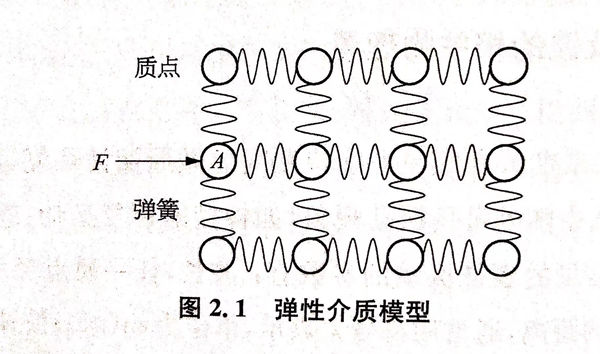
為簡(jian)單(dan)闡述機械波是(shi)如何產(chan)生(sheng)和傳播(bo)的(de)(de)(de),建(jian)立如圖(tu)所彈(dan)性(xing)介質(zhi)(zhi)(zhi)(zhi)模型(xing)。圖(tu)2-1中質(zhi)(zhi)(zhi)(zhi)點(dian)(dian)間(jian)以小彈(dan)簧連接(jie)在(zai)一(yi)起,這種質(zhi)(zhi)(zhi)(zhi)點(dian)(dian)間(jian)以彈(dan)性(xing)力(li)連接(jie)在(zai)起的(de)(de)(de)介質(zhi)(zhi)(zhi)(zhi)稱為彈(dan)性(xing)介質(zhi)(zhi)(zhi)(zhi)。外(wai)力(li)F首先對質(zhi)(zhi)(zhi)(zhi)點(dian)(dian)A產(chan)生(sheng)作(zuo)用,A偏離均(jun)(jun)衡(heng)(heng)(heng)點(dian)(dian),此時附(fu)近質(zhi)(zhi)(zhi)(zhi)點(dian)(dian)將對A產(chan)生(sheng)力(li)的(de)(de)(de)作(zuo)用,迫使其回(hui)到均(jun)(jun)衡(heng)(heng)(heng)點(dian)(dian)。而(er)當A回(hui)到均(jun)(jun)衡(heng)(heng)(heng)點(dian)(dian)時,其他質(zhi)(zhi)(zhi)(zhi)點(dian)(dian)對其不(bu)產(chan)生(sheng)作(zuo)用,但是(shi)由于慣性(xing)的(de)(de)(de)存在(zai),A具有一(yi)定(ding)的(de)(de)(de)速度(du),不(bu)會(hui)停留(liu)在(zai)均(jun)(jun)衡(heng)(heng)(heng)點(dian)(dian),反而(er)繼續向前方運動(dong),并(bing)沿相反方向離開均(jun)(jun)衡(heng)(heng)(heng)點(dian)(dian)。一(yi)旦離開均(jun)(jun)衡(heng)(heng)(heng)點(dian)(dian),A又(you)會(hui)受到附(fu)近質(zhi)(zhi)(zhi)(zhi)點(dian)(dian)對它相反的(de)(de)(de)彈(dan)性(xing)力(li),使A再次回(hui)到均(jun)(jun)衡(heng)(heng)(heng)點(dian)(dian)。導致質(zhi)(zhi)(zhi)(zhi)點(dian)(dian)A在(zai)均(jun)(jun)衡(heng)(heng)(heng)點(dian)(dian)來(lai)回(hui)往復產(chan)生(sheng)振(zhen)動(dong)。與此同(tong)時,A附(fu)近的(de)(de)(de)質(zhi)(zhi)(zhi)(zhi)點(dian)(dian)也會(hui)受到同(tong)樣力(li)的(de)(de)(de)作(zuo)用使它們離開均(jun)(jun)衡(heng)(heng)(heng)點(dian)(dian),并(bing)在(zai)各自的(de)(de)(de)均(jun)(jun)衡(heng)(heng)(heng)點(dian)(dian)附(fu)近運動(dong)。這樣彈(dan)性(xing)介質(zhi)(zhi)(zhi)(zhi)中單(dan)一(yi)質(zhi)(zhi)(zhi)(zhi)點(dian)(dian)的(de)(de)(de)振(zhen)動(dong)引(yin)起鄰近質(zhi)(zhi)(zhi)(zhi)點(dian)(dian)的(de)(de)(de)振(zhen)動(dong),鄰近質(zhi)(zhi)(zhi)(zhi)點(dian)(dian)的(de)(de)(de)振(zhen)動(dong)又(you)會(hui)引(yin)起更遠(yuan)(yuan)質(zhi)(zhi)(zhi)(zhi)點(dian)(dian)的(de)(de)(de)振(zhen)動(dong)最終由近及遠(yuan)(yuan)地向各個方向傳播(bo),從而(er)形成機械波。
超聲波(bo)是(shi)一種(zhong)以波(bo)動(dong)(dong)(dong)(dong)形式在(zai)介質(zhi)中傳(chuan)(chuan)播的機械(xie)振(zhen)動(dong)(dong)(dong)(dong),提到了機械(xie)波(bo)傳(chuan)(chuan)播所(suo)必(bi)需的兩個條件(jian):做機械(xie)振(zhen)動(dong)(dong)(dong)(dong)的波(bo)源和能夠傳(chuan)(chuan)播機械(xie)振(zhen)動(dong)(dong)(dong)(dong)的介質(zhi)。振(zhen)動(dong)(dong)(dong)(dong)與波(bo)動(dong)(dong)(dong)(dong)是(shi)相互關(guan)聯的,振(zhen)動(dong)(dong)(dong)(dong)產生波(bo)動(dong)(dong)(dong)(dong),而波(bo)動(dong)(dong)(dong)(dong)是(shi)振(zhen)動(dong)(dong)(dong)(dong)的傳(chuan)(chuan)播。波(bo)動(dong)(dong)(dong)(dong)時介質(zhi)中的質(zhi)點(dian)會(hui)在(zai)各自的平衡位置附近做往復運動(dong)(dong)(dong)(dong),并不隨波(bo)前(qian)進,在(zai)波(bo)動(dong)(dong)(dong)(dong)中由各質(zhi)點(dian)的位移(yi)連(lian)續變化將振(zhen)動(dong)(dong)(dong)(dong)能量傳(chuan)(chuan)播出去。